
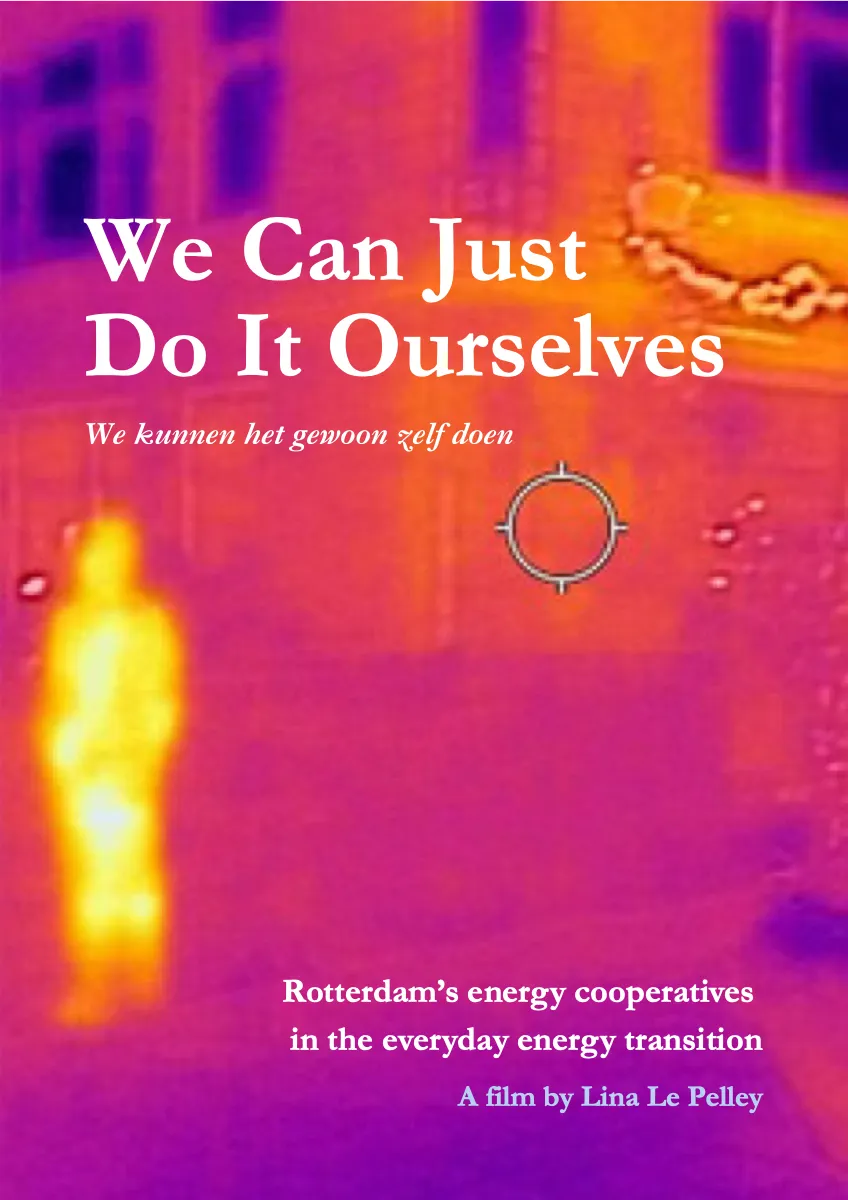
We Can Just Do It Ourselves
By
Lina Le Pelley
Synopsis
Over the years, it has become clear that a major shift towards renewable energy cannot succeed through technical innovation alone. A growing interest in the social side of the energy transition, and how this change is realized on a practical, neighborhood-level, informs this ethnographic study of energy cooperatives in the city of Rotterdam, the Netherlands.
We Can Just Do It Ourselves (We kunnen het gewoon zelf doen) is an ethnographic film whose narrative is guided by several protagonists who are active organizers in the energy community of Carnisse/Charlois, and the energy cooperatives Blijstroom (Rotterdam Noord), and Alex Energiek (Prins Alexander) respectively. The film examines their focus on community-building, how they activate networks at different scales, and the practical ways in which they make the energy transition tangible for fellow residents in their neighborhoods. In a volatile geopolitical climate, amidst continued fossil fuel dependency and rising costs of living on a macro level, a “micro” focus on these local initiatives provides valuable perspective.
Through their work, these Rotterdam residents strive to tackle energy poverty and to strengthen their communities – rather than being dependent on top-down solutions, they want to take matters into their own hands and do it themselves.
Bio
I am a (visual) anthropologist interested in social and environmental justice. Growing up in different countries, especially Namibia and Uganda, introduced me to critical perspectives on culture, (de)colonization, and sustainability. After a bachelor’s at Leiden University in anthropology and sociology, I did a master’s in Cultural Anthropology at the University of Amsterdam, conducting ethnographic fieldwork in Namibia on colonial reparations efforts between Namibia and Germany. I returned to Leiden University to study Visual Ethnography, where my multimodal master’s research focused on Rotterdam’s energy cooperatives. With experience in science communication, my research aims to be relevant and politically charged, yet interesting and accessible. I aspire for my work to give back, both in the process and in the output.